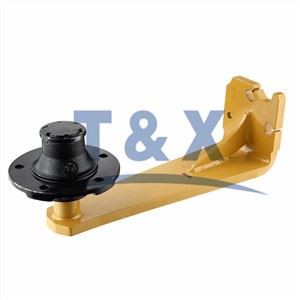

Hey there! As a supplier of Aluminum Forging Parts, I often get asked about the magnetic properties of these parts. So, I thought I'd take a deep - dive into this topic and share what I know.
First off, let's talk a bit about aluminum itself. Aluminum is a non - ferromagnetic metal. Ferromagnetic materials are those that can be strongly magnetized and are attracted to magnets. Think of iron, nickel, and cobalt – these are classic ferromagnetic materials. Aluminum doesn't fall into this category.
The reason for aluminum's non - ferromagnetic nature lies in its atomic structure. In ferromagnetic materials, the atoms have unpaired electrons whose spins can align in the same direction, creating a net magnetic moment. When an external magnetic field is applied, these magnetic moments can be oriented to produce a strong magnetic effect.
In aluminum, the electrons are arranged in such a way that there isn't a significant net magnetic moment. Each electron's magnetic contribution is more or less canceled out by another electron within the atom. So, on a macroscopic scale, aluminum doesn't show a strong response to a magnetic field like ferromagnetic materials do.
But that doesn't mean aluminum has zero interaction with magnetic fields. Aluminum is actually paramagnetic. Paramagnetism is a much weaker form of magnetism compared to ferromagnetism. When you place aluminum in a magnetic field, it gets a very weak magnetic moment in the direction of the applied field. However, this effect is so weak that you won't notice it in everyday situations.
For example, if you try to pick up an aluminum forging part with a regular household magnet, nothing will happen. The magnetic force exerted by the magnet on the aluminum is just too small to overcome the force of gravity or the friction holding the part in place.
Now, how does this property matter in the context of aluminum forging parts? Well, it has several implications.
One of the big advantages is in applications where you don't want magnetic interference. For instance, in the electronics industry, magnetic fields can disrupt the operation of sensitive components. Aluminum forging parts can be used in enclosures or structural elements of electronic devices because they won't introduce unwanted magnetic fields. This helps in maintaining the proper functioning of the electronics inside.
Another area where the non - ferromagnetic property of aluminum forging parts is useful is in the food and beverage industry. In food processing equipment, magnetic materials can attract metal particles, which could contaminate the food. Since aluminum doesn't have this magnetic attraction, it's a safer choice for parts in contact with food.
In transportation, especially in aerospace and automotive applications, weight is a crucial factor. Aluminum is known for its low density, and its non - ferromagnetic property is an added bonus. It allows for the design of lightweight components without the worry of magnetic interference with on - board systems.
Let's also touch on how the forging process might affect the magnetic properties of aluminum. During forging, the aluminum is heated and shaped under high pressure. This process changes the grain structure of the metal. But despite these structural changes, the fundamental magnetic properties of aluminum remain the same. The forging doesn't introduce any significant ferromagnetic behavior.
However, impurities can sometimes have an impact. If there are traces of ferromagnetic elements like iron in the aluminum alloy used for forging, it could potentially increase the magnetic response of the part. But in high - quality aluminum forging parts, the impurity levels are carefully controlled to ensure that the overall non - ferromagnetic and slightly paramagnetic nature of the material is maintained.
Now, if you're in the market for high - quality aluminum forging parts, you might also be interested in our Wearable Construction Tips WS39 Cutter. These cutters are precision - forged and made to withstand the rigors of construction work. And if you're looking for something different, we also offer Carbon Steel Forging Parts. Carbon steel has its own unique set of properties, including different magnetic characteristics compared to aluminum.


If you're considering purchasing aluminum forging parts for your project, whether it's for electronics, food processing, or transportation, I'd love to have a chat with you. We can discuss your specific requirements, and I'm confident we can provide you with the right parts that meet your needs. Just reach out to start the procurement process and let's see how we can work together to get you the best aluminum forging parts.
In conclusion, the magnetic properties of aluminum forging parts – being non - ferromagnetic and slightly paramagnetic – make them a great choice for a wide range of applications. Their lack of strong magnetic interaction allows for use in many industries where magnetic interference is a concern, and the forging process doesn't change these fundamental properties significantly. So, if you're in need of reliable aluminum forging parts, don't hesitate to get in touch.
References
- "Introduction to Solid State Physics" by Charles Kittel
- "Materials Science and Engineering: An Introduction" by William D. Callister, Jr. and David G. Rethwisch