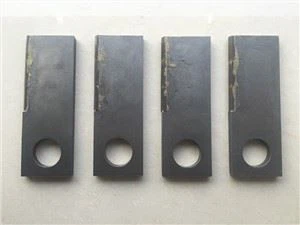

As a seasoned supplier of machining parts, I've witnessed firsthand the pivotal role that form accuracy plays in the manufacturing industry. Form accuracy refers to how closely the actual shape of a machined part conforms to its intended design. In this blog, I'll delve into the key requirements for achieving high form accuracy in machining parts, sharing insights gained from years of experience in the field.
Geometric Tolerancing
Geometric tolerancing is the foundation of form accuracy. It allows engineers to define the allowable variation in the shape, orientation, location, and runout of features on a part. By specifying geometric tolerances on engineering drawings, manufacturers can ensure that parts fit together properly and function as intended.
One of the most common geometric tolerances is flatness. Flatness ensures that a surface is perfectly flat within a specified tolerance zone. This is crucial for parts that require a smooth mating surface, such as engine blocks or machine bases. Another important tolerance is cylindricity, which ensures that a cylindrical feature is perfectly round and straight along its axis. Cylindricity is essential for parts like shafts and bearings, where precise rotational motion is required.


In addition to flatness and cylindricity, other geometric tolerances include straightness, circularity, profile of a surface, and perpendicularity. Each tolerance serves a specific purpose and must be carefully considered during the design and manufacturing process.
Machining Processes
The choice of machining processes has a significant impact on form accuracy. Different machining processes have different levels of precision and are suitable for different types of parts. For example, turning is a common process used to create cylindrical parts, while milling is used to create flat surfaces and complex shapes.
CNC (Computer Numerical Control) machining is a popular choice for achieving high form accuracy. CNC machines use computer-controlled tools to remove material from a workpiece with high precision. This allows for consistent and repeatable machining, ensuring that parts meet the required specifications.
Another important factor in machining processes is the selection of cutting tools. The type, size, and geometry of the cutting tools can affect the surface finish and form accuracy of the machined part. For example, a sharp cutting tool with the correct geometry can produce a smoother surface finish and reduce the risk of tool wear and breakage.
Material Selection
The choice of material also plays a role in form accuracy. Different materials have different properties, such as hardness, toughness, and thermal expansion coefficient, which can affect the machining process and the final form of the part.
For example, materials with high hardness can be more difficult to machine and may require specialized cutting tools and machining processes. On the other hand, materials with low thermal expansion coefficients are less likely to warp or deform during the machining process, resulting in higher form accuracy.
In addition to material properties, the quality of the raw material is also important. Defects in the raw material, such as porosity or inclusions, can affect the form accuracy of the machined part. Therefore, it's essential to select high-quality raw materials from reliable suppliers.
Inspection and Quality Control
Inspection and quality control are essential for ensuring form accuracy. Throughout the manufacturing process, parts should be inspected using various measurement techniques to verify that they meet the required specifications.
One of the most common measurement techniques is coordinate measuring machines (CMMs). CMMs use a probe to measure the coordinates of points on a part's surface, allowing for accurate measurement of dimensions, geometric tolerances, and surface finish. Other measurement techniques include optical measurement systems, laser scanners, and tactile measurement devices.
In addition to in-process inspection, final inspection is also crucial. Before parts are shipped to customers, they should be thoroughly inspected to ensure that they meet all the required specifications. This includes visual inspection, dimensional inspection, and functional testing.
Examples of High-Form-Accuracy Parts
To illustrate the importance of form accuracy, let's take a look at some examples of high-form-accuracy parts.
- Graphite Self-lubricating Copper Sleeve: These sleeves require high form accuracy to ensure proper fit and function. The inner and outer diameters must be precisely machined to the specified tolerances to provide smooth operation and reduce friction.
- Hub Axles: Hub axles are critical components in automotive and industrial applications. They must be machined with high precision to ensure proper alignment and rotation of the wheels or other components. Any deviation from the specified form can lead to premature wear, noise, and even safety issues.
- Machined Pins Construction Machinery Parts: These pins are used in construction machinery to connect various components. They require high form accuracy to ensure a secure and reliable connection. The diameter, length, and straightness of the pins must be carefully controlled to meet the requirements of the application.
Conclusion
In conclusion, achieving high form accuracy in machining parts requires a combination of factors, including geometric tolerancing, machining processes, material selection, and inspection and quality control. By paying attention to these factors and using the latest technologies and techniques, manufacturers can produce parts that meet the most demanding specifications.
If you're in the market for high-quality machining parts with excellent form accuracy, I invite you to contact us for a consultation. Our team of experts has the knowledge and experience to provide you with the best solutions for your specific needs. We look forward to working with you to achieve your manufacturing goals.
References
- "Geometric Dimensioning and Tolerancing Handbook" by William H. Yates
- "Machining Fundamentals" by Robert L. Sawyer
- "Manufacturing Engineering and Technology" by Serope Kalpakjian and Steven R. Schmid