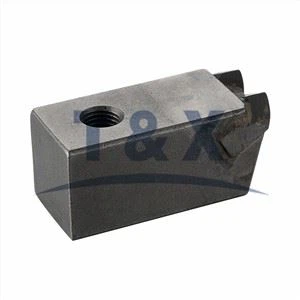

As a supplier of Ductile Iron Parts, I've witnessed firsthand the remarkable properties and wide - ranging applications of these components. Ductile iron, also known as nodular cast iron, offers numerous advantages such as high strength, good ductility, and excellent wear resistance. However, like any material, it has its limitations. In this blog, I'll delve into the various limitations of Ductile Iron Parts to provide a comprehensive understanding for potential customers.
1. Cost Considerations
One of the primary limitations of Ductile Iron Parts is the cost involved in their production. The manufacturing process of ductile iron is more complex compared to some other materials. It requires precise control of the chemical composition, especially the addition of magnesium to convert the graphite flakes into spherical nodules. This process demands advanced equipment and skilled labor, which significantly increases the production cost.
In addition, the raw materials used for ductile iron, such as high - quality iron ore and alloying elements, can be relatively expensive. These cost factors are ultimately passed on to the customer, making Ductile Iron Parts more costly than some alternative materials. For businesses operating on tight budgets or those producing high - volume, low - cost products, the higher price of ductile iron can be a deterrent.

2. Machinability Challenges
Ductile iron has a unique microstructure that can pose challenges when it comes to machining. The presence of graphite nodules in the matrix can cause issues such as tool wear and surface finish problems. When cutting ductile iron, the graphite nodules can act as stress concentrators, leading to chipping and breakage of cutting tools. This not only reduces the tool life but also increases the machining costs due to frequent tool replacements.
Moreover, achieving a smooth surface finish on Ductile Iron Parts can be difficult. The graphite nodules can cause a rough texture on the machined surface, which may require additional finishing operations such as grinding or polishing. These extra steps add to the production time and cost. For applications where a high - precision and smooth surface finish are crucial, the machinability limitations of ductile iron can be a significant drawback.
3. Corrosion Resistance
Although ductile iron has some level of corrosion resistance, it is not as corrosion - resistant as some other materials such as stainless steel. In environments with high humidity, exposure to chemicals, or saltwater, ductile iron is prone to corrosion. The corrosion process can lead to the formation of rust, which weakens the structure of the parts over time.
To enhance the corrosion resistance of Ductile Iron Parts, additional protective coatings are often required. These coatings add to the cost and complexity of the production process. Moreover, the effectiveness of the coatings depends on the application method and the quality of the coating material. If the coating is damaged or not applied correctly, the underlying ductile iron will be exposed to the corrosive environment, leading to corrosion.
4. Weight
Ductile iron is a relatively heavy material compared to some other metals such as aluminum. In applications where weight is a critical factor, such as in the automotive and aerospace industries, the high weight of Ductile Iron Parts can be a limitation. The additional weight can increase fuel consumption in vehicles and reduce the overall efficiency of the system.
For example, in the automotive industry, manufacturers are constantly looking for ways to reduce the weight of vehicles to improve fuel economy. Using Ductile Iron Parts may not be the best option in such cases, as lighter materials like aluminum or carbon fiber composites can provide similar strength with less weight.
5. Design Limitations
The casting process of ductile iron has certain design limitations. Due to the shrinkage characteristics of ductile iron during solidification, it can be challenging to produce complex - shaped parts with high precision. The shrinkage can cause defects such as porosity, shrinkage cavities, and warping in the cast parts.
To minimize these defects, special design considerations need to be taken into account, such as the use of risers and gating systems. However, these additional design features can increase the complexity and cost of the casting process. In some cases, it may not be possible to achieve the desired design using ductile iron, and alternative materials or manufacturing processes may need to be considered.
6. Heat Resistance
While ductile iron has good mechanical properties at room temperature, its performance at high temperatures is limited. At elevated temperatures, the strength and ductility of ductile iron can decrease significantly. The graphite nodules in the microstructure can grow and coalesce, leading to a loss of strength.
In applications where high - temperature resistance is required, such as in the automotive engine components or industrial furnaces, Ductile Iron Parts may not be suitable. Other materials such as heat - resistant alloys or ceramics are often preferred in these high - temperature environments.
7. Fatigue Resistance
Although ductile iron has good ductility, its fatigue resistance is not as high as some other materials. In applications where the parts are subjected to cyclic loading, such as in machinery and automotive components, the fatigue life of Ductile Iron Parts can be a concern.
The presence of graphite nodules in the microstructure can act as stress concentrators, which can initiate cracks under cyclic loading. These cracks can propagate over time, leading to failure of the part. To improve the fatigue resistance of Ductile Iron Parts, additional heat treatment or surface treatment processes may be required, which add to the production cost.
8. Environmental Impact
The production of Ductile Iron Parts has a significant environmental impact. The manufacturing process involves high - energy consumption, as well as the emission of pollutants such as carbon dioxide and particulate matter. The extraction and processing of raw materials also contribute to environmental degradation.
In today's environmentally conscious world, businesses are increasingly looking for materials and manufacturing processes that have a lower environmental impact. The relatively high environmental footprint of ductile iron production can be a limitation for companies that are committed to sustainable development.
Despite these limitations, Ductile Iron Parts still have many advantages and are widely used in various industries. For example, they are commonly used in the manufacturing of pipes, automotive components, and machinery parts. If you are considering using Ductile Iron Parts for your project, it's important to weigh the limitations against the benefits and determine if they are the right choice for your specific application.
If you are interested in our Ductile Iron Parts, or if you have any questions about their limitations and suitability for your project, please feel free to contact us for a detailed discussion. We can provide you with more information and help you make an informed decision. And if you are looking for Grey Iron Or Ductile Iron Disc Harrow Spool, you can visit Grey Iron Or Ductile Iron Disc Harrow Spool for more details.
References
- ASM Handbook, Volume 1: Properties and Selection: Irons, Steels, and High - Performance Alloys.
- Cast Iron Technology: Principles and Processes by John Campbell.
- "Ductile Iron: A Material for the Future" by The Ductile Iron Society.