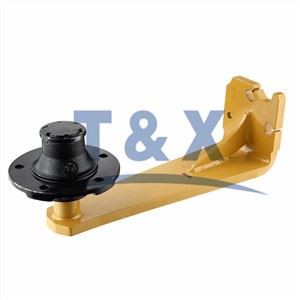

As a supplier of steel casting parts, I've had my fair share of dealing with the importance of quality control. One of the key aspects of ensuring the quality of our steel casting parts is through non-destructive testing (NDT) methods. These methods are crucial as they allow us to assess the integrity of the parts without causing any damage to them. In this blog, I'll walk you through some of the common non-destructive testing methods we use for steel casting parts.

Visual Inspection
Let's start with the most basic and straightforward method: visual inspection. This is the first step in our quality control process. It's simple but super important. We just take a good look at the steel casting parts to check for any obvious surface defects like cracks, porosity, or misruns. Sometimes, we use magnifying glasses or microscopes to get a closer look at the details.
Visual inspection doesn't require any fancy equipment, and it can give us a quick idea of the part's condition. But it does have its limitations. It can only detect surface defects, and some small defects might be missed, especially if they're hidden in hard-to-reach areas.

Dye Penetrant Testing
Next up is dye penetrant testing. This method is great for finding surface-breaking defects. Here's how it works: First, we apply a brightly colored dye to the surface of the steel casting part. The dye seeps into any cracks or pores on the surface. After letting it sit for a while, we wipe off the excess dye and apply a developer. The developer draws the dye out of the defects, making them visible as bright-colored indications.
Dye penetrant testing is relatively easy to perform and can detect very small surface defects. It's also quite cost-effective. However, it can only detect surface defects, and the part needs to have a clean and smooth surface for accurate results.
Magnetic Particle Testing
Magnetic particle testing is another useful method for detecting surface and near-surface defects in ferromagnetic steel casting parts. We use a magnetic field to induce magnetic poles in the part. If there's a defect, it disrupts the magnetic field, creating a leakage field. We then apply iron particles to the surface, and these particles are attracted to the leakage field, forming visible indications of the defect.
This method is fast and sensitive, and it can detect both surface and near-surface defects. But it's only applicable to ferromagnetic materials, and the part needs to be relatively clean and free of contaminants for accurate results.
Ultrasonic Testing
Ultrasonic testing is a powerful method for detecting internal defects in steel casting parts. We use high-frequency sound waves to penetrate the part. When the sound waves encounter a defect, they're reflected back, and we can detect these reflections using a transducer. By analyzing the time it takes for the sound waves to travel and the amplitude of the reflections, we can determine the location, size, and type of the defect.
Ultrasonic testing can detect internal defects that are not visible on the surface, and it can be used to test parts of various shapes and sizes. However, it requires skilled operators and specialized equipment, and the results can be affected by factors like the shape and structure of the part.
Radiographic Testing
Radiographic testing uses X-rays or gamma rays to create an image of the internal structure of the steel casting part. The rays pass through the part and expose a film or digital detector on the other side. Defects appear as darker or lighter areas on the image, depending on their density compared to the surrounding material.
This method can provide detailed information about the internal structure of the part, and it can detect a wide range of defects, including porosity, cracks, and inclusions. However, it requires expensive equipment and strict safety precautions due to the use of radiation.
Eddy Current Testing
Eddy current testing is mainly used for detecting surface and near-surface defects in conductive materials, including steel casting parts. We use a coil to generate an alternating magnetic field, which induces eddy currents in the part. If there's a defect, it disrupts the eddy currents, and we can detect these changes using a detector.
Eddy current testing is fast and sensitive, and it can be used to test parts without contact. But it's mainly suitable for detecting surface and near-surface defects, and the results can be affected by factors like the conductivity and magnetic properties of the material.
Why Non-Destructive Testing Matters for Our Steel Casting Parts
As a supplier of steel casting parts, we understand the importance of delivering high-quality products to our customers. Non-destructive testing methods play a crucial role in ensuring the quality and reliability of our parts. By using these methods, we can detect and eliminate defects early in the production process, reducing the risk of product failure and customer dissatisfaction.
For example, our Trailer Connector Parts need to be of the highest quality to ensure safe and reliable operation. Non-destructive testing helps us ensure that these parts are free of defects and meet the required standards. Similarly, our OEM Casting Cross Bit & Lost Bit and High Chrome Wear Parts also benefit from non-destructive testing, as it helps us maintain their performance and durability.
Conclusion
In conclusion, non-destructive testing methods are essential for ensuring the quality and integrity of our steel casting parts. Each method has its own advantages and limitations, and we often use a combination of methods to get a comprehensive assessment of the parts. By investing in these testing methods, we can provide our customers with high-quality steel casting parts that meet their needs and expectations.
If you're in the market for high-quality steel casting parts, I encourage you to get in touch with us for a procurement discussion. We're always happy to talk about how our products can fit your requirements.

References
- American Society for Nondestructive Testing (ASNT). "Non-Destructive Testing Handbook."
- ASTM International. "Standards for Non-Destructive Testing of Metals."