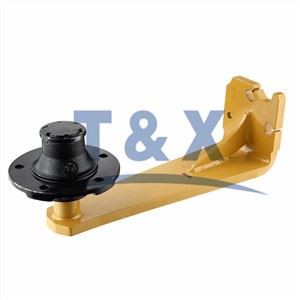

Ductile iron, also known as nodular cast iron or spheroidal graphite iron, is a type of cast iron that has been widely used in various industries due to its excellent mechanical properties. One of the most significant advantages of ductile iron parts is their wear resistance, which makes them suitable for applications where friction and abrasion are prevalent. As a ductile iron parts supplier, I am often asked about the wear resistance properties of ductile iron. In this blog post, I will explore the factors that influence the wear resistance of ductile iron parts and discuss its applications in different industries.

Factors Affecting the Wear Resistance of Ductile Iron Parts
Microstructure
The microstructure of ductile iron plays a crucial role in determining its wear resistance. Ductile iron consists of graphite nodules embedded in a metallic matrix. The shape, size, and distribution of these graphite nodules, as well as the type of matrix, can significantly affect the wear behavior of the material.
- Graphite Nodules: The graphite nodules in ductile iron act as lubricants, reducing friction and wear. Spherical graphite nodules are more effective in providing lubrication compared to flake graphite in grey iron. A high nodularity (the percentage of graphite in spherical form) and a uniform distribution of nodules result in better wear resistance.
- Metallic Matrix: The matrix of ductile iron can be various types, such as ferrite, pearlite, or a combination of both. Pearlite has a higher hardness than ferrite, and thus, ductile iron with a pearlitic matrix generally exhibits better wear resistance. However, ferrite provides better ductility, which can be beneficial in some applications where impact loading is involved.
Hardness
Hardness is another important factor that influences the wear resistance of ductile iron parts. Generally, harder materials are more resistant to wear. By controlling the heat treatment process, the hardness of ductile iron can be adjusted to meet the specific requirements of different applications. For example, heat treatment methods like quenching and tempering can increase the hardness of the material, thereby improving its wear resistance.
Alloying Elements
Alloying elements can be added to ductile iron to enhance its wear resistance. Elements such as chromium, molybdenum, nickel, and copper can improve the strength, hardness, and corrosion resistance of the material. Chromium, for instance, forms hard carbide particles in the matrix, which can significantly increase the wear resistance of ductile iron. Molybdenum can also improve the hardenability and high - temperature strength of the material, making it more suitable for applications in harsh environments.
Surface Finish
The surface finish of ductile iron parts can affect their wear resistance. A smooth surface finish reduces the contact area between the part and the mating surface, thereby reducing friction and wear. Machining processes such as grinding and polishing can be used to achieve a high - quality surface finish, which is especially important in applications where low - friction and high - precision are required.
Applications of Ductile Iron Parts with High Wear Resistance
Automotive Industry
In the automotive industry, ductile iron parts with excellent wear resistance are widely used. For example, brake components such as brake drums and brake discs are often made of ductile iron. The high wear resistance of ductile iron ensures long - term performance and reliability of these components, even under high - temperature and high - stress conditions. Additionally, engine components like crankshafts and camshafts can also be made of ductile iron due to its good combination of strength, toughness, and wear resistance.
Mining Industry
The mining industry involves a lot of abrasive and high - impact operations. Ductile iron parts are commonly used in mining equipment such as crushers, conveyors, and pumps. The wear - resistant properties of ductile iron make it suitable for these applications, where parts are exposed to hard rocks, minerals, and other abrasive materials. For example, crusher liners made of ductile iron can withstand the continuous impact and abrasion from the crushed materials, reducing the frequency of replacement and maintenance.
Agricultural Industry
In the agricultural sector, ductile iron parts are used in various farming equipment. One such example is the Grey Iron Or Ductile Iron Disc Harrow Spool. The disc harrow spool made of ductile iron needs to resist the abrasion caused by soil, rocks, and other debris during farming operations. The wear resistance of ductile iron ensures that the spool can operate effectively for a long time, reducing the downtime and cost of replacement.
Evaluating the Wear Resistance of Ductile Iron Parts
There are several methods to evaluate the wear resistance of ductile iron parts. One common method is the pin - on - disc test, where a pin made of the test material is rubbed against a rotating disc under a constant load. The amount of material loss is measured over a certain period, and the wear rate is calculated. This test can simulate different wear conditions, such as dry sliding wear, abrasive wear, and adhesive wear.
Another method is the block - on - ring test, which is similar to the pin - on - disc test but uses a block instead of a pin. This test can provide more accurate results for larger - scale applications. Additionally, field tests are also conducted to evaluate the wear resistance of ductile iron parts in real - world conditions. These tests involve installing the parts in actual equipment and monitoring their performance over time.
Conclusion
As a ductile iron parts supplier, I understand the importance of wear resistance in various applications. Ductile iron offers a unique combination of mechanical properties, including high wear resistance, ductility, and strength. The wear resistance of ductile iron parts can be influenced by factors such as microstructure, hardness, alloying elements, and surface finish. By carefully controlling these factors during the manufacturing process, we can produce ductile iron parts that meet the specific wear - resistance requirements of different industries.
If you are looking for high - quality ductile iron parts with excellent wear resistance, I invite you to contact me for further discussions and potential procurement. I am committed to providing you with the best products and services to meet your business needs.
References
- ASM Handbook Volume 1: Properties and Selection: Irons, Steels, and High - Performance Alloys.
- International Journal of Minerals, Metallurgy, and Materials.
- Journal of Materials Science and Technology.