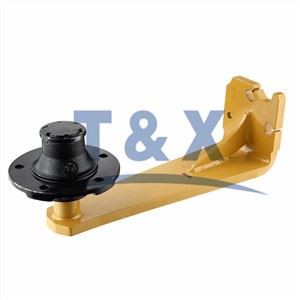

As a seasoned supplier of Trailer Wheel Hubs, I've witnessed firsthand the importance of understanding the differences between cast and forged trailer wheel hubs. These components are crucial for the safety and performance of trailers, and choosing the right type can make a significant difference in the long run. In this blog post, I'll delve into the key differences between cast and forged trailer wheel hubs, helping you make an informed decision for your trailer needs.
Manufacturing Processes
Cast Trailer Wheel Hubs
Casting is a manufacturing process where molten metal is poured into a mold to take the shape of the desired part. For trailer wheel hubs, this typically involves pouring molten steel or aluminum into a pre - designed mold. The metal then cools and solidifies, taking on the form of the wheel hub.
One of the main advantages of casting is its ability to produce complex shapes with relative ease. This means that cast trailer wheel hubs can have intricate designs, which may be beneficial for certain applications. Additionally, casting is generally a more cost - effective process, especially for large - scale production. It allows for the mass production of wheel hubs at a lower cost per unit.
However, casting also has its drawbacks. The cooling process can sometimes lead to internal defects such as porosity, which are small holes or voids in the metal. These defects can weaken the structure of the wheel hub and reduce its overall strength and durability.
Forged Trailer Wheel Hubs
Forging, on the other hand, is a process that involves applying compressive forces to a heated piece of metal to shape it into the desired form. In the case of trailer wheel hubs, a solid piece of metal is heated to a high temperature and then hammered or pressed into the shape of the hub.
Forging results in a much denser and more uniform metal structure compared to casting. The compressive forces during forging align the metal grains, which significantly enhances the strength and toughness of the wheel hub. Forged trailer wheel hubs are generally able to withstand higher levels of stress and impact without deforming or breaking.
The main disadvantage of forging is its higher cost. The process requires more energy, specialized equipment, and skilled labor. As a result, forged trailer wheel hubs are typically more expensive than their cast counterparts.
Strength and Durability
Cast Trailer Wheel Hubs
Cast wheel hubs have a certain level of strength, but they are generally not as strong as forged ones. The internal defects that can occur during the casting process, such as porosity, can act as stress concentrators. When the wheel hub is under load, these stress concentrations can lead to crack initiation and propagation, eventually causing the hub to fail.
However, for light - duty trailers or applications where the loads are relatively low, cast trailer wheel hubs can be a suitable choice. They are often used in small trailers, utility trailers, and some recreational trailers.


Forged Trailer Wheel Hubs
Forged trailer wheel hubs are known for their superior strength and durability. The aligned metal grains and dense structure make them highly resistant to deformation and cracking. They can handle heavy loads, high - speed operation, and rough terrains much better than cast hubs.
Forged hubs are commonly used in heavy - duty trailers, such as commercial trailers, semi - trailers, and industrial trailers. They are also preferred in applications where safety is of utmost importance, as they provide a higher level of reliability under extreme conditions.
Weight
Cast Trailer Wheel Hubs
Cast wheel hubs are usually heavier than forged ones. The casting process often results in a thicker cross - section of the metal to ensure structural integrity, which adds to the overall weight of the hub. This extra weight can have a negative impact on the fuel efficiency of the trailer and the towing vehicle. It can also increase the wear and tear on other components, such as the suspension and brakes.
Forged Trailer Wheel Hubs
Forged trailer wheel hubs can be designed to be lighter while still maintaining their strength. The ability to precisely control the metal flow during forging allows for the creation of thinner but stronger sections of the hub. This weight reduction can improve the fuel efficiency of the trailer and reduce the stress on other components, leading to longer service life.
Cost
Cast Trailer Wheel Hubs
As mentioned earlier, cast trailer wheel hubs are generally more cost - effective. The casting process is less complex and requires less energy and specialized equipment compared to forging. This makes them a popular choice for budget - conscious customers or for applications where cost is a major factor.
Forged Trailer Wheel Hubs
Forged trailer wheel hubs come with a higher price tag. The cost of the raw materials, the energy required for forging, and the skilled labor involved all contribute to the increased cost. However, when considering the long - term benefits of strength, durability, and performance, the higher initial investment in forged hubs can often be justified.
Applications
Cast Trailer Wheel Hubs
Cast trailer wheel hubs are commonly used in light - duty applications. They are suitable for small trailers used for personal use, such as boat trailers, camping trailers, and small utility trailers. These trailers typically carry relatively light loads and do not require the high - strength characteristics of forged hubs.
Forged Trailer Wheel Hubs
Forged trailer wheel hubs are the preferred choice for heavy - duty applications. They are used in commercial trailers that transport large and heavy loads, such as freight trailers, tanker trailers, and flatbed trailers. In addition, they are also used in industrial trailers and military trailers, where reliability and performance under extreme conditions are essential.
Conclusion
In conclusion, the choice between cast and forged trailer wheel hubs depends on several factors, including the type of trailer, the load it will carry, the operating conditions, and the budget. Cast trailer wheel hubs are a cost - effective option for light - duty applications, offering a good balance between cost and performance. On the other hand, forged trailer wheel hubs provide superior strength, durability, and performance, making them ideal for heavy - duty and high - stress applications.
As a supplier of Trailer Wheel Hubs Spindle, Flange Parts, and Machined Pins Construction Machinery Parts, we can offer a wide range of cast and forged trailer wheel hubs to meet your specific needs. If you're in the market for trailer wheel hubs, we encourage you to contact us to discuss your requirements and explore the best options for your trailer. Our team of experts is ready to assist you in making the right choice and ensuring the safety and performance of your trailer.
References
- "Manufacturing Processes for Engineering Materials" by S. Kalpakjian and S. R. Schmid
- "Mechanical Properties of Metals" by G. E. Dieter
- Industry reports on trailer component manufacturing and performance.