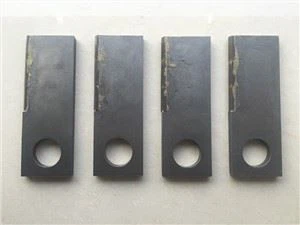

In the realm of manufacturing, steel casting parts play a pivotal role across various industries. As a dedicated supplier of steel casting parts, I've witnessed firsthand the importance of adhering to strict standards. These standards not only ensure the quality and reliability of the products but also contribute to the overall efficiency and safety of the applications in which they are used.
Material Quality
One of the fundamental standards for steel casting parts lies in the quality of the raw materials. The choice of steel grade is crucial as it determines the mechanical properties of the final product. For instance, high - strength steels are often used in applications where parts need to withstand heavy loads or extreme conditions. We carefully select the steel grades based on the specific requirements of our customers.
When it comes to alloy steels, such as the 42CrMo Alloy Steel Harden Fishtail Bit, the composition of the alloy elements must be precisely controlled. The presence of elements like chromium and molybdenum enhances the hardenability, strength, and toughness of the steel. Our quality control team conducts rigorous chemical analysis of the raw materials to ensure that the composition meets the specified standards. This analysis is typically done using advanced spectroscopy techniques, which can accurately measure the percentage of each element in the steel.
Dimensional Accuracy
Dimensional accuracy is another critical standard in the steel casting industry. Parts must be manufactured to the exact specifications provided by the customer. Even a small deviation in dimensions can lead to problems during assembly or operation. For example, in the case of a Precision Cast Trailer Connector, a slight difference in the size of the connection points can result in a loose or unstable connection, which is a safety hazard.
We use advanced machining and inspection techniques to achieve high - dimensional accuracy. Computer - Numerical - Control (CNC) machining is employed to precisely shape the casting parts. After machining, the parts are thoroughly inspected using coordinate measuring machines (CMMs). These machines can measure the dimensions of the parts with high precision, ensuring that they are within the tolerance limits specified by the customer.
Surface Finish
The surface finish of steel casting parts is not only important for aesthetic reasons but also for functional purposes. A smooth surface finish can reduce friction, prevent corrosion, and improve the overall performance of the part. In applications where the part comes into contact with other components, a good surface finish can also reduce wear and tear.
We employ various surface treatment processes to achieve the desired surface finish. For example, grinding and polishing can be used to remove any rough edges or irregularities on the surface of the casting. Additionally, coatings can be applied to enhance the corrosion resistance of the part. In the case of a Cast Flail Cutter, a smooth and corrosion - resistant surface finish is essential to ensure its long - term performance in harsh environments.
Mechanical Properties
The mechanical properties of steel casting parts, such as tensile strength, yield strength, and hardness, are key standards that must be met. These properties determine the ability of the part to withstand different types of loads and stresses. For example, in structural applications, parts need to have high tensile strength to support heavy loads without breaking.
We conduct mechanical testing on our steel casting parts to ensure that they meet the required mechanical properties. Tensile tests are performed to measure the maximum stress a part can withstand before breaking. Hardness tests, such as the Rockwell or Brinell hardness tests, are used to determine the hardness of the part. These tests are carried out in accordance with international standards, such as ASTM (American Society for Testing and Materials) or ISO (International Organization for Standardization).
Defect Control
Defects in steel casting parts can significantly affect their performance and reliability. Common defects include porosity, cracks, and inclusions. Porosity can weaken the part and reduce its fatigue life, while cracks can lead to sudden failure. Inclusions, such as non - metallic particles, can also affect the mechanical properties of the part.


We have a comprehensive defect control system in place to minimize the occurrence of defects. During the casting process, we use advanced techniques to ensure proper filling of the mold and solidification of the steel. After casting, the parts are inspected using non - destructive testing methods, such as ultrasonic testing, X - ray testing, and magnetic particle testing. These methods can detect internal and surface defects without damaging the part. Any parts with defects are either repaired or rejected, ensuring that only high - quality parts are delivered to our customers.
Quality Management System
To ensure that all the standards for steel casting parts are met consistently, we have implemented a strict quality management system. This system includes procedures for raw material inspection, process control, and final product inspection. Our quality management system is based on international standards, such as ISO 9001, which provides a framework for ensuring quality in all aspects of our operations.
We regularly train our employees on quality control procedures and ensure that they are aware of the importance of meeting the standards. Our quality control team conducts regular audits to ensure that all processes are being followed correctly. By having a well - established quality management system, we can provide our customers with high - quality steel casting parts that meet their specific requirements.
Industry Standards and Certifications
In addition to our internal quality control measures, we also comply with various industry standards and certifications. These standards and certifications are recognized globally and provide assurance to our customers that our products meet the highest quality levels. For example, we are certified to ISO 9001, which demonstrates our commitment to quality management. We also comply with industry - specific standards, such as those set by the automotive, aerospace, and construction industries.
By adhering to these standards and certifications, we can expand our market reach and build long - term relationships with our customers. Our customers can be confident that the steel casting parts they purchase from us are of the highest quality and meet all the necessary requirements.
Conclusion
As a supplier of steel casting parts, we understand the importance of meeting the standards in the industry. From material quality and dimensional accuracy to surface finish and mechanical properties, every aspect of the manufacturing process is carefully controlled to ensure the production of high - quality parts. By adhering to strict quality management systems and industry standards, we can provide our customers with reliable and durable steel casting parts.
If you are in need of high - quality steel casting parts, we invite you to contact us for a detailed discussion. Our team of experts is ready to assist you in finding the right solutions for your specific requirements. Whether you need a 42CrMo Alloy Steel Harden Fishtail Bit, a Precision Cast Trailer Connector, or a Cast Flail Cutter, we have the expertise and resources to meet your needs.
References
- ASTM International. (2023). Standards for steel materials and testing.
- ISO. (2023). International standards for quality management systems.
- ASM Handbook. (2023). Properties and selection: Irons, steels, and high - performance alloys.