
As a supplier of lost wax casting parts, I've had the privilege of witnessing the remarkable versatility and precision of this manufacturing process. Lost wax casting, also known as investment casting, has been around for centuries and continues to be a vital method for producing high - quality metal parts across various industries. Understanding the stress - distribution characteristics of lost wax casting parts is crucial for ensuring their performance, reliability, and longevity.


1. Basics of Lost Wax Casting
Before delving into stress - distribution, it's important to briefly understand how lost wax casting works. The process begins with creating a wax pattern of the desired part. This wax pattern is then coated with a ceramic shell, which is hardened through a series of drying and firing steps. Once the shell is strong enough, the wax is melted out, leaving a cavity in the shape of the part. Molten metal is then poured into this cavity. After the metal solidifies, the ceramic shell is broken away, revealing the finished casting.
The precision of lost wax casting allows for the production of complex shapes with high dimensional accuracy and excellent surface finish. This makes it suitable for parts in aerospace, automotive, medical, and many other industries where tight tolerances and fine details are required.
2. Factors Affecting Stress Distribution in Lost Wax Casting Parts
2.1 Geometric Design
The shape of a lost wax casting part plays a significant role in stress distribution. Complex geometries with sudden changes in cross - section, sharp corners, or thin walls can create stress concentrations. For example, a part with a sharp internal corner will experience higher stress levels compared to a part with a rounded corner. Stress concentrations can lead to premature failure of the part, especially under cyclic loading.
When designing lost wax casting parts, engineers need to pay close attention to fillet radii, wall thicknesses, and overall part symmetry. By optimizing the geometric design, stress can be more evenly distributed throughout the part, improving its strength and durability.
2.2 Material Properties
The choice of material for lost wax casting also affects stress distribution. Different metals and alloys have varying mechanical properties such as yield strength, ultimate tensile strength, and modulus of elasticity. For instance, a high - strength alloy will be able to withstand higher stress levels before yielding compared to a lower - strength material.
The microstructure of the casting material also matters. During the solidification process, the formation of grain boundaries, dendrites, and other microstructural features can influence how stress is transferred through the material. A fine - grained microstructure generally provides better mechanical properties and more uniform stress distribution compared to a coarse - grained one.
2.3 Casting Defects
Casting defects such as porosity, shrinkage cavities, and inclusions can have a detrimental effect on stress distribution. Porosity, which is the presence of small voids in the casting, can act as stress concentrators. When stress is applied to a part with porosity, the stress will be concentrated around the voids, increasing the likelihood of crack initiation and propagation.
Shrinkage cavities occur when the metal shrinks during solidification and there is insufficient molten metal to fill the space. These cavities can weaken the part and disrupt the normal stress flow. Inclusions, which are foreign particles trapped in the casting, can also cause stress concentrations and reduce the overall strength of the part.
3. Stress - Distribution Characteristics in Different Applications
3.1 Aerospace Applications
In the aerospace industry, lost wax casting parts are used in critical components such as turbine blades and engine mounts. These parts are subjected to high temperatures, high - speed rotation, and complex loading conditions. The stress - distribution in aerospace castings needs to be carefully managed to ensure safe and reliable operation.
Turbine blades, for example, experience centrifugal forces due to rotation, as well as thermal stress caused by the high - temperature environment. The blade design must be optimized to distribute these stresses evenly to prevent blade failure. Advanced computational methods such as finite element analysis (FEA) are often used to simulate stress distribution in aerospace lost wax casting parts during the design phase.
3.2 Automotive Applications
Automotive lost wax casting parts include engine components, transmission parts, and suspension components. These parts are exposed to dynamic loading, vibrations, and varying temperatures. For example, engine blocks made by lost wax casting need to withstand the high - pressure combustion forces and thermal cycling.
To ensure proper stress distribution in automotive castings, manufacturers often use heat treatment processes to improve the material's mechanical properties. Additionally, the design of the parts is carefully engineered to minimize stress concentrations and ensure that the stress is evenly distributed across the component.
3.3 Medical Applications
In the medical field, lost wax casting is used to produce implants such as hip and knee joints. These implants need to be biocompatible and able to withstand the mechanical stresses of daily use. The stress - distribution in medical implants is critical for their long - term success.
Medical implants are designed to mimic the natural bone structure as closely as possible to ensure proper stress transfer. The use of advanced materials and precise manufacturing techniques in lost wax casting helps to achieve the required stress - distribution characteristics, reducing the risk of implant failure and improving patient outcomes.
4. Analyzing Stress Distribution in Lost Wax Casting Parts
4.1 Finite Element Analysis (FEA)
FEA is a powerful tool for analyzing stress distribution in lost wax casting parts. It involves creating a virtual model of the part and applying various loads and boundary conditions to simulate real - world operating conditions. The software then calculates the stress and strain distribution throughout the part.
By using FEA, engineers can identify potential stress concentrations early in the design process and make necessary design modifications. This helps to optimize the part design, reduce the risk of failure, and improve the overall performance of the casting.
4.2 Experimental Testing
In addition to FEA, experimental testing is also important for validating stress - distribution predictions. Techniques such as strain gauges can be used to measure the actual strain (and hence stress) at specific points on the casting. Photoelasticity is another method that can be used to visualize the stress distribution in a transparent model of the part.
Experimental testing provides valuable data that can be used to verify the accuracy of FEA models and to ensure that the casting meets the required performance standards.
5. Our Products and Their Stress - Distribution Considerations
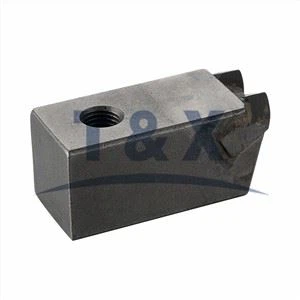
As a supplier of lost wax casting parts, we offer a wide range of products, including 42CrMo Alloy Steel Harden Fishtail Bit, Lost Wax Casting Cross Bit & Lost Bit, and Cast Flail Cutter.
For the 42CrMo Alloy Steel Harden Fishtail Bit, which is used in drilling applications, the stress - distribution is carefully considered to ensure that the bit can withstand the high - pressure and high - torque forces during drilling. The design of the bit is optimized to distribute the stress evenly across the cutting edges and the body of the bit, reducing the risk of bit breakage.
The Lost Wax Casting Cross Bit & Lost Bit are commonly used in mining and construction. These parts are subjected to heavy impact and abrasion. Our engineers use advanced design and manufacturing techniques to ensure that the stress is distributed evenly, improving the durability and performance of the bits.
The Cast Flail Cutter is used in agricultural and forestry machinery. It experiences dynamic loading and vibrations during operation. To ensure proper stress distribution, the cutter design is optimized, and the material is carefully selected to provide the necessary strength and toughness.
6. Conclusion and Call to Action
Understanding the stress - distribution characteristics of lost wax casting parts is essential for producing high - quality, reliable components. By considering factors such as geometric design, material properties, and casting defects, and using advanced analysis and testing methods, we can ensure that our lost wax casting parts meet the strict requirements of various industries.
If you are in need of high - quality lost wax casting parts, we invite you to contact us for procurement and further discussions. Our team of experienced engineers and technicians is ready to work with you to provide customized solutions that meet your specific stress - distribution and performance requirements.
References
- Campbell, J. (2003). Castings. Butterworth - Heinemann.
- Kalpakjian, S., & Schmid, S. R. (2009). Manufacturing Engineering and Technology. Pearson Prentice Hall.
- Dossett, L. A., & Bralla, J. G. (2007). Casting, Forming, and Welding Handbook. McGraw - Hill.