
As a die casting parts supplier, I've been deeply involved in the world of die casting for many years. One of the most critical aspects in the die casting process is the gating ratio for parts. The gating system in die casting plays a vital role in determining the quality, efficiency, and overall success of the production of die casting parts. In this blog, I'll delve into the requirements for the die - casting die gating ratio for parts, sharing insights from my practical experience and industry knowledge.
Understanding the Gating System in Die Casting
Before we discuss the gating ratio, it's essential to understand what the gating system is. The gating system in die casting is a set of channels and passages that allow the molten metal to flow from the shot sleeve into the die cavity. It consists of several components, including the sprue, runner, gate, and overflow. The sprue is the main channel through which the molten metal enters the die. The runner distributes the molten metal from the sprue to the gates, which are the openings that allow the metal to enter the die cavity. Overflows are used to collect excess metal and gases, improving the quality of the final part.
The gating ratio refers to the cross - sectional area relationships between different parts of the gating system, typically expressed as the ratio of the cross - sectional area of the sprue (A_s), runner (A_r), and gate (A_g), i.e., A_s:A_r:A_g. This ratio is crucial because it affects the flow rate, velocity, and pressure of the molten metal as it fills the die cavity.
Requirements for the Gating Ratio
1. Filling Time and Flow Rate
The gating ratio has a direct impact on the filling time of the die cavity. A proper gating ratio ensures that the molten metal fills the cavity in a timely and uniform manner. If the gating ratio is too large, the flow rate of the molten metal may be too high, leading to turbulence, air entrapment, and splashing. On the other hand, if the gating ratio is too small, the filling time may be too long, resulting in premature solidification of the metal and incomplete filling of the cavity.
For example, in the production of Aluminum Die Casting Parts, a well - designed gating ratio can help maintain an optimal flow rate of the molten aluminum. Aluminum has a relatively low melting point and good fluidity, but it also oxidizes easily. A proper gating ratio can minimize the exposure of the molten aluminum to air during the filling process, reducing the formation of oxide inclusions in the final part.
2. Pressure Distribution
The gating ratio also affects the pressure distribution within the die cavity. During the die casting process, the molten metal needs to be injected into the cavity under high pressure. A balanced gating ratio helps to distribute the pressure evenly across the cavity, ensuring that the metal fills all the corners and details of the part.
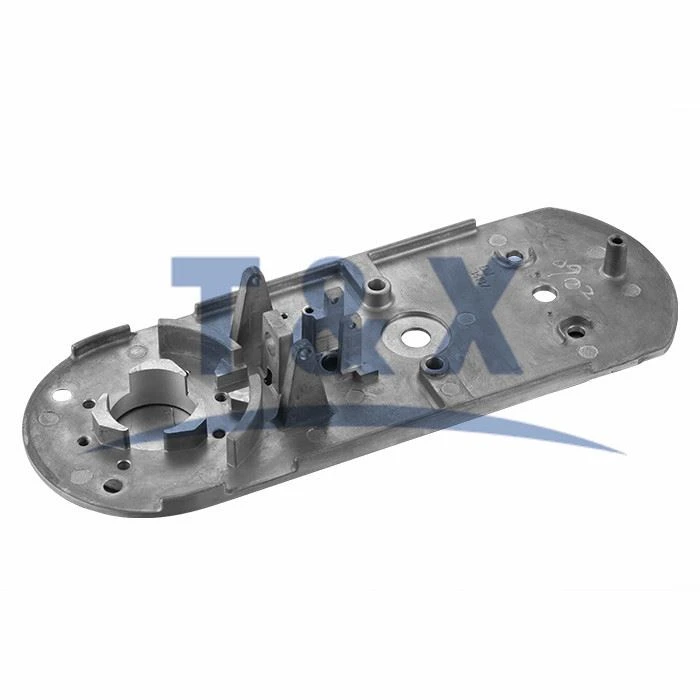
In the case of complex - shaped die casting parts, an improper gating ratio can lead to uneven pressure distribution. This may result in areas of the part being under - filled or over - filled, causing defects such as porosity, shrinkage, and dimensional inaccuracies. For instance, in the production of Zinc Die Casting Parts, zinc has a relatively high density and solidifies quickly. A well - designed gating ratio is necessary to ensure that the pressure is sufficient to fill the entire cavity before the zinc solidifies, while also preventing excessive pressure that could cause die wear or part deformation.
3. Metal Temperature and Solidification
The gating ratio can influence the temperature of the molten metal as it flows through the gating system and into the die cavity. A proper gating ratio helps to maintain the temperature of the molten metal within an appropriate range. If the gating ratio is not optimized, the molten metal may lose too much heat during the filling process, leading to premature solidification.
Premature solidification can cause a variety of defects in the final part, such as cold shuts, where two streams of molten metal meet but do not fully fuse together. In addition, the gating ratio can also affect the solidification pattern of the metal in the cavity. A well - designed gating ratio can promote directional solidification, which is beneficial for reducing porosity and improving the mechanical properties of the part.
Factors Affecting the Gating Ratio
1. Part Geometry
The shape and size of the die casting part are significant factors in determining the gating ratio. Complex - shaped parts with thin walls, deep cavities, or intricate details require a different gating ratio compared to simple - shaped parts. For example, parts with thin walls need a higher flow rate of molten metal to ensure complete filling, which may require a different gating ratio to increase the velocity of the metal.
2. Metal Alloy
Different metal alloys have different physical properties, such as melting point, density, and fluidity. These properties affect the flow behavior of the molten metal and, therefore, the required gating ratio. For example, magnesium alloys have a very low density and high fluidity, which may allow for a different gating ratio compared to copper alloys, which have a higher density and lower fluidity.

3. Die Casting Machine
The type and capacity of the die casting machine also play a role in determining the gating ratio. The injection pressure, speed, and shot volume of the machine need to be considered when designing the gating system. A high - pressure die casting machine may require a different gating ratio compared to a low - pressure die casting machine to achieve the desired filling and quality of the part.
Optimizing the Gating Ratio
To determine the optimal gating ratio for a specific die casting part, a combination of theoretical calculations, computer simulations, and practical testing is often required.
Theoretical Calculations
Based on the principles of fluid mechanics, theoretical calculations can be used to estimate the flow rate, velocity, and pressure of the molten metal in the gating system. These calculations take into account factors such as the cross - sectional area of the gating components, the length of the channels, and the properties of the metal alloy.
Computer Simulations
Computer - aided engineering (CAE) software can be used to simulate the flow of molten metal in the die cavity. These simulations can provide detailed information about the filling process, including the filling time, pressure distribution, and temperature changes. By adjusting the gating ratio in the simulation, the optimal ratio can be determined to achieve the best filling and quality of the part.
Practical Testing
Even with theoretical calculations and computer simulations, practical testing is still necessary to validate the gating ratio. Prototypes are produced using different gating ratios, and the quality of the parts is inspected. Based on the test results, the gating ratio can be further optimized to meet the requirements of the final production.
Conclusion
In conclusion, the gating ratio for die casting parts is a critical factor that affects the quality, efficiency, and success of the die casting process. As a die casting parts supplier, I understand the importance of getting the gating ratio right. By considering factors such as filling time, pressure distribution, metal temperature, part geometry, metal alloy, and die casting machine, and using a combination of theoretical calculations, computer simulations, and practical testing, we can optimize the gating ratio for each specific part.
If you're in the market for high - quality die casting parts, whether it's Aluminum Die Casting Parts or Zinc Die Casting Parts, we're here to provide you with the best solutions. Our team of experts has extensive experience in designing and manufacturing die casting parts with optimized gating ratios. We invite you to contact us for procurement and to discuss your specific requirements. Let's work together to achieve the best results for your die casting projects.
References
- Campbell, J. (2003). Castings. Butterworth - Heinemann.
- Groover, M. P. (2017). Fundamentals of Modern Manufacturing: Materials, Processes, and Systems. Wiley.
- Tiryakioglu, M., & Kocak, M. (2017). Light Metals Casting: Understanding the Solidification Behavior of Light Alloys. Elsevier.